Tuesday, October 25, 2011

Eastern State Penitentiary

Title: Beware the Lily Law
Year: March 2011
Material: Prison bed, A/V equipment, costumes, actors, built into prison cell
Creator:  
Michelle Handelman
Performers: Becca Blackwell, Michael Lynch
Cinematography: Ed David
Sound Design: Vincent Baker
Sound Mix: Dan Bora
Production Assistance: Nadja Marcin
“Spare Change for a Dying Queen” by Jimmy Carnicio
Collection: Artist Installations, adult content cell block


Eastern State Penitentiary has been trying to find ways to bring more people to the museum outside of the haunting season. One of the programs offered to do this are artist installations. These installations are temporary exhibits that are thought provoking or educational that bring to light the history and issues associated with prisons, prisoners, or the personell.


Down the cell block reserved for 'adult content' are some of these installations. All are labeled 'mature content' and this block is marked to feature 'adult content' not recommended for children. One of these is titled “Beware the Lily Law,” created by Michelle Handelman. "Lily Law" was one of the many names street youth used in place of "cops". The piece is installed in one of the cells, which has been arranged to look like it is currently in use. A projector hidden above the doorway on the inside of the cell places the image of the actor (presumably an inmate living in this cell). Also above the doorway are speakers. Together, this creates the illusion that the character on screen lives in the cell and is talking to you (the viewer). The viewer is able to sit inside the cell on a stool and listen to the story of the subject, including what life was like being transgendered before they were incarcerated, how they were arrested, and what their life is like now in the prison. Two subjects are featured (one after the other, and the video is on loop), and both are 'caught on tape' performing the daily routines that allow them to "pass". The first is male to female (shown putting on her makeup), the second female to male (shown working out and then binding his breasts). Each subject tells his or her story about being arrested at the Stonewall Inn during the 1969 Stonewalll Riots in New York City during which police raided the bar and arrested transgendered patrons.

Even today these prisoners are placed in the prisons in which they legally are identified as, meaning female transgenders are placed in male prisons, and males in female prisons. For their protection they are often placed in administrative custody, but this creates mental stress because such custody is essentially solitary confinement.

The installation is not only thought-provoking but highly controversial. An LGBT ally may watch this and be moved through either sadness or anger at seeing what life is like in prison for a transgendered person. Someone who does not have a stance on the subject or is unfamiliar with transgendered people may not understand what the 'big deal' is. Finally, someone who is does not agree with the transgendered lifestyle, is homophobic, or easily offended would likely be disgusted by not only seeing and hearing from a transgendered person but perhaps may be upset that the art piece was even installed. 

The artist clearly is an LGBT ally as the work only features the point of view from that side of the movement for equal rights between homosexuals, heterosexuals, and the people 'in between'. This insinuates that the museum is also supportive, even though it may be attempting to just make the issue known but not take sides.


For anyone unfamiliar with the troubles dealt with by the transgendered community, it would be greatly beneficial to research further into the subject.

Sunday, October 16, 2011

The Philadelphia Zoo


Title: Black-Tailed Prairie Dogs Cynomys ludovicianus
Year: Unknown
Material: Wood, acrylic, fiberglass, cement, sand, dirt, hummus (other materials unknown)
Creator:  Unknown
Collection: Prairie Dogs

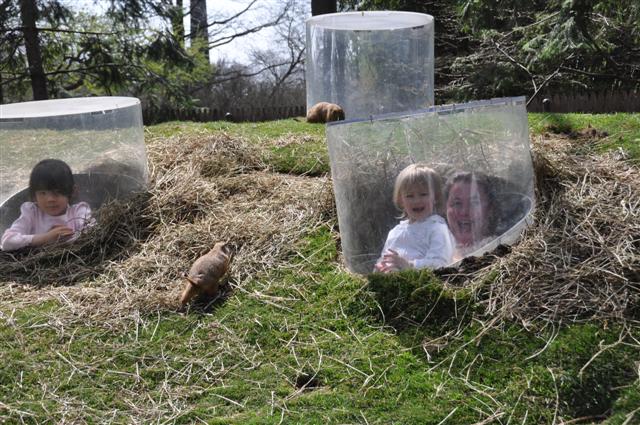
The black-tailed prairie dog exhibit is located on the east side of the zoo near to Bird Lake and the Treehouse. It is an open top exhibit, with low sides so that people (including children) can see the lookouts from afar. This also allows the prairie dogs to survey the area, which would stress them if they were prevented from such.  According to the zoo's website, the most common intruder that the prairie dog scouts look for are the free-range peacocks. The exhibit does not merely consist of what can be seen by the naked eye, however. The colony consists of fifty to sixty individuals, runs eight feet deep, and consists of a network of tunnels and living chambers.

Though this species is listed as "Of Least Concern" on the IUCN Redlist, it is relevant to the zoo as a whole in that it brings attention to species that are 'closer to home'. In addition, prior to 2004 black-tailed prairie dogs were listed as a candidate species to be added to the Endangered Species Act. Their populations were brought up through a combination of land management, education, population management (they are susceptible to the plague), and the placement of a ban on using prairie dogs in the exotic pet trade (this ban was lifted in 2008 however). In fact, the population has increased so dramatically that in some areas they are now considered pests by farmers (who, on that note, may not be interested in seeing a prairie dog exhibit and may even voice this opinion upon viewing such).

None of the above information can be found on the signage located at the prairie dog exhibit, however. Instead, the only interpretations consist of two signs: information on breeding cycles, and a description of the job of a lookout as well as how to identify them. The natural history and demographics of the prairie dogs can be found on the website, but no information is included on their conservation history. It is readily available common knowledge in the zoologic field (as well as the pet trade) that can be found on practically any website, but the average visitor would not think to look for such information.

Showcasing the success in increasing the prairie dog population is vital to the zoo's mission of conservation. Instead  of merely showing 'cute animals' in the middle of an otherwise exhibit-less area, the surroundings could be redesigned to immerse the visitor in 'prairie dog country'. Other zoos have built an interactive directly into a prairie dog exhibit, however this would not be an ideal project for a zoo that already has a complex enclosure built. One idea would be to devise a play area that models the network of tunnels that prairie dogs live in (this would be big enough for adults too, of course). This would help visitors to understand the extent to which prairie dogs organize their colonies. Signage could include comparisons of the size of  recorded prairie dog colonies to places like football fields, airports, and even counties. Finally, interpretations should be included extrapolating on the progress the prairie dog has made as a total population to emphasize the fact that conservation efforts do in fact work.

Wednesday, October 12, 2011

The American Swedish Historical Museum


Title: Tapestry
Year: 1938
Material: Wool and linen
Creator:  Designed by Märta Måås-Fjetterström, embroidered by twelve women from different provinces of Sweden
Collection: The Fredrika Bremer Room

The tapestry hangs in the back of a recreated mid-19th century Swedish parlor at them American Swedish Historical Museum in Philadelphia. The tapestry, combined with the other objects in the display, help the viewer to better understand the comfortable life Fredrika Bremer grew up with and sacrificed to help others. It features selected quotes from the writings of Fredrika Bremer, chosen by the Swedish Fredrika Bremer Room Committee.

The text translates:
The narrow valley widens
Paths becomemore numerous
There shall be room work
Lightheartedness enough for all
Who honestly seek and desire
If one has felt deeply a single
Grief then one understands
All other sufferers
Every deep longing is a
Prophecy of fulfillment
Every earnest seeking has the promise of finding
Is not faith the royal highway
Of the spirit to that other
All-highest access over the mountain
Gift of Swedish women
It is on display as an homage to both Fredrika Bremer and Swedish women everywhere. It also helps to "set the scene" of the parlor display. It appears the tapestry was made specifically for this room in 1938.

The label describes the tapestry as being "designed by one of Sweden's most famous weaving artists," thereby pointing out the importance of the item and also praising it.

If one is interested in learning more about the tapestry, further readings in the Fredrika Bremer room about her as well as studies of her life and works outside of the museum would help to gain insight. As the Fredrika Bremer room focuses on her work as a philanthropist and women's rights activist, people who are not interested in the history of women's rights or social work would likely not be interested in this room, much less the tapestry. An opposing point of view of the tapestry may come from someone who disagrees with the passages woven into the tapestry.

To further engage viewers with the tapestry, it may prove beneficial to feature a table nearby with the works of Fredrika Bremer that these passages came from so that viewers can read on.

Tuesday, October 4, 2011

The Philadelphia Museum of Art


Title:   Horse Armor of Duke Ulrich of Württemberg for use in the field
Year:   1507
Material:   [Armor] embossed, etched, and partially blued and gilded steel; tail plate replaced; brass; leather; [saddle] birch bark; steel; leather and textiles replaced
Creator:   Wilhelm von Worms the Elder (armorer), German, active Nuremberg, master in 1499, died 1538; and anonymous Nuremberg graphic artist.
Collection:   The Kretzschmar von Kienbusch Collection of Arms and Armor


This work is the most prominently displayed piece in The Kretzschmar von Kienbusch Collection of Arms and Armor at the Phildelphia Museum of Art. For the purposes of this examination, I will focus solely on the horse armor, as it was the only complete set of horse armor within the amory, wheras there were a number of suits displayed. The horse armor was made for Duke Ulrich of Württemberg, who served under the German king Maximilian. It is likely this armor was created for accompanying the king to Rome in 1508, but the king's trip never happened. He was known for his excessive spending on extravagances, as shown in detailed graphics on the armor (which would have been unnecessary for the field).  It is not only important because of the history of its owner, but also because of its creator and its unique qualities. It is the earliest complete set outside of Europe and the only surviving horse armor created by Wilhelm von Worms, who was famous for his skilled craftsmanship. This rich history is my guess as to why it is displayed, in addition the the beautiful craftsmanship and etchings.


The armor was acquired through a gift of Athena and Nicholas Karabots and the Karabots Foundation in 2009. The gallery itself is five rooms (two smaller rooms on either side of the main room). The armor is displayed on the sculpture of a horse, placed on a small stage at the center back of the room, perfectly centered between two windows. The entire room has been decorated in such a way as to "set the scene". Other objects in the room include more suits of armor, spears, shields, stained glass, and even a faux crow perched in one of the "castle" windows. 


A suit of armor has been put together and placed on top of the horse, posed as if riding to create the illusion of a knight and his horse prepared for battle. On either side are descriptions of the armor (the left being the knight's suit, the right being the horse's armor). 


The interpretation is written concisely in third person, and includes information not only on the armor but the armorer and the Duke. Despite the author's attempt to make the information appear impartial, however, their admiration of the work is apparent.


The study of European armor, German craftsmanship, or German history may all be useful subjects to focus on. As a fan of history in general, old trades, and reenactment (and an occasional reenactor myself) I was interested in studying practically anything in this gallery. Someone who does not enjoy studying the subject of arms or armaments  may not be interested in the horse armor, much less the gallery as a whole. As the label did not at all describe the dislike many of the Duke's subjects have for him or his infamous history, someone familiar with this may have something to say about the unnecessary extravagance of the horse's armor. The presence of an interpreter may engage viewers with the subject, though this likely exists for tours already. I would be hesitant to add any sort of interactive or additional decor to the room, as it is very fitting already and the inclusion of technology would contradict the theme. 

Thursday, September 22, 2011

The Rosenbach Museum


Title: Megalonyx jeffersonii
Year: Disc. 1796
Material: Fossilized bone, copy from resin.
Creator: Disc. by Colonel John Stewart, studies initiated by Thomas Jefferson
Collection: Creature Comforts

In the back left corner of the small exhibit that was Creature Comforts at the Rosenbach Museum was a collection of fossils from the Megalonyx jeffersonii (Jefferson's giant ground sloth) specimen that was discovered by Colonel John Stewart in 1796 in the Blue Ridge Mountains, West Virginia. It was sent from Col. Stewart to Thomas Jefferson upon exhuming, who after studying the fossils was convinced that it was not only from a large carnivore (a massive cat) but that the animal was still roaming the largely unpopulated American wilderness. His presentation to the American Philosophical Society beginning his search for this creature and further evidence is what has caused some scholars to consider Jefferson as the father of American vertebrate paleontology. 


The fossils are on display as part of the Creature Comforts exhibition, inspired by the natural history literature collected by the Rosenbach brothers. One of the items collected by them was a letter from Thomas Jefferson to David Rittenhouse pertaining to the fossil and his beliefs in the species remaining extant. The fossils themselves were gifted by the American Philosophical Society to the Academy of Natural Sciences, who have loaned the collection (among other natural history items) to the Rosenbach for this exhibition. 

The collection of objects that create the ground sloth exhibit as a whole are dispersed throughout four different places. The focus of my evaluation (the fossils) are in a single case, raised on two different mounts. The left mount features the forearm, and the right mount the left hand of the ground sloth. Above the case is a quote from Thomas Jefferson's Notes on the State of Virginia, "But all the manna of heaven would never raise the Mouse to the bulk of the Mammoth". To the right of the case is a small pedestal where an exact replica of the largest left claw is available for visitors to touch and examine. As noted in the description of the object (found in the center of the main case) is a reference to the letter that is on display in a separate case, as well as an invitation to utilize the computer kiosk upon which visitors can access the Academy's website.

The point of view of the label and website is mostly that of modern science looking back at the early scientific views of the late 18th century. The other objects in the exhibition are tied into the same focus and point of view, in that the articles are collected from older literature or assist in explaining such, mostly from the late 18th and 19th centuries. 

A closer study of natural history, especially American vertebrate paleontology would help one to better understand the fossils. I personally a brief spent time in my mammology courses studying the ground sloths, so I find these articles quite interesting. Someone not interested in scientific fields, especially those of paleontology or natural history may not be interested in the objects, however. 

Someone who disagrees with the studies of Thomas Jefferson (or the beginnings of American natural history and paleontology as a whole) might tell an opposing narrative in that the description of the item would focus on his misunderstandings of what we now believe today to be the "factual" scientific history of the ground sloth. 

I do not think any more "experiences" are necessary to add to the experience and engagement with the object. What might be useful, however, is to include directions in the item's description as to where the letter is located (I spent several minutes searching and still could not find which case it was in until I was shown), or simply putting the letter into the same case as the fossils. 

Monday, September 19, 2011

The National Constitution Center

Title: Flags of the United States of America
Year: 2003
Material: Metal, fabric, wire (for hanging flags), stone
Creator: Unknown
Collection: Lobby

Creating a half-circle above the second floor of the main lobby to the National Constitution Center is a long row of flags. These flags are those of the United States' fifty states, as well as the unincorporated territories. The individual flags are important to those people who have a special tie to that state or territory, and the collection as a whole is important to anyone who is a citizen of the United States, or perhaps not but wishes to understand more about the country. The flags are on display to not only recognize the individual regions of the country, but to show the order in which the states and territories became a part of the United States.

I am unsure of how the individual flags were acquired, but I would venture to guess they were either donated by members of the individual states, or purchased directly by the center. The flags are hung from wire attached to a metal mount that encircles the center edge of the second floor of the lobby. Below each of these flags is an engraved block of stone laid into the floor with the name of the state or territory the flag represents, and the date it became a part of the United States (the first thirteen are in order of ratification of the Constitution). What I found most interesting was the fact the mount for the flags extended past the last territory  perhaps on purpose to leave room in case more are acquired. The point of view of these labels are objective-- there is no additional information given as to the history of each state, and so there is nothing written that might effect how the objects were interpreted.

There are no other objects around the flags that might contribute to an understanding of the exhibit. There is however a life-sized board game, and perhaps there are questions in the game we did not come across that are relevant to the flags. The significance of the flags might be better understood following research into the history of the growth of the United States, and after studying the laws that determine statehood versus being an unincorporated territory. Someone not from the United States that does not understand the significance of individual states might not be interested in the flags. As there is no point of view involved with the interpretation of the object, it would be hard for a different narrative to be told about it. The only opposing point of view I might expect to hear would be a complaint by someone that the territories are included in the series despite them not being a state.

Viewers might become more engaged with the display if there was an interpretation perhaps along the wall of the second floor walkway describing a brief history of the state and its acquisition by the United States. This could also be achieved with brief discussions given by an interpreter.

Wednesday, September 14, 2011

Favorite Object

This blog will serve as a place to discuss objects seen at a variety of museums and other such institutions throughout the semester. 


Name: Dagretha
Year I received it: 2008
Material: Tempered hickory core backed in laminating clear fiber glass. The belly of the bow is                birdseye zebrawood and the handle is aromatic cedar.
Creator: Goyacle Redtail

Dagretha is a longbow with a draw weight of 28" or 25x lbs.
This object holds special meaning for me in several ways. Firstly, it was made by a good friend who is a professional Hopi bowyer. Secondly it was an experiment in a new method he was testing, so it is the first of its kind from his collection. Lastly the accents were painted by me, inspired by the bow used by my favorite character in an online role-playing game I used to be a part of. The name of the bow is the name of the organization my character belonged to, so I am constantly reminded of the friendships I had that grew in the game (some people I still talk to today).

The object was a gift from my friend because he does not sell his experiments, and he knew I was in the market for a bow and appreciated his work. It was delivered by his girlfriend (my roommate).

The bow is not exactly on display as I have it off to a corner in my room with the rest of my weaponry, far from the vents and windows to protect it from the elements. It is not stored in a bowsock, though, so when my door is closed, the bow is visible. One day I do intend to mount it to a wall somewhere to display it.

The other weaponry stored with the bow include some arrows, a blow gun, my boyfriend's shinai, and a spear. This spear was made by me out of foam and wood for a costume so it is not functional however. Also in that corner is a trash can I painted to match the bedroom, my closet, and a floor length mirror. In examining these objects, one might see that I like to be organized efficiently, appreciate aesthetics and take part in the arts, and have an interest in "old-technology" weaponry.

To better understand the bow, it would be useful to gain more information about it directly from its creator. Also, a study of archery, bowmaking, and the Hopi people would be advised.

People uninterested in gaming and fantasy may be turned off by the story behind the bow's accents and name. Archers who do not like longbows and people who do not enjoy archery or disapprove of weaponry in general would also not be interested in this bow.

Someone who is unaware of the name of the bow and the storyline of the MUD game may just see the roses painted on it as a pretty decoration and nothing more. They may even derive different meaning from the roses, such as associating thorns with the sharp point of an arrow. Someone unaware of who made the bow may think I bought it. A person disapproving of archery or hunting may assume I am a hunter, which may cause other inferences and misunderstandings to be made.

Whenever someone asks, I allow them to touch it. The best way to create interest in a functional object is to demonstrate its function, so taking the bow out to a range and teaching a viewer on how to use it would be an ideal way to engage him or her.