Showing posts with label history. Show all posts

Wednesday, December 14, 2011

The African American Museum


Title:  Rev. Richard Allen and Absalom Jones
Year:  2011
Material: A/V equipment, wood, paint
Creator:  Unknown
Collection: Audacious Freedom


Much like the moving portrait at Eastern State Penitentiary, the African American Museum features  'talking pictures' in one of their current exhibitions, Audacious Freedom. Rather than there being just one of these portraits, however, the museum has taken this a step further and hosts a number of these portraits on the second floor. Each is of an individual important to the African American community in Philadelphia from as far back as the initial colonization of America by Europeans. The actors have been filmed with vivid colors and bright lighting to look as if they were painted. Buttons are found to the right of each portrait where questions may be asked of the characters.


Only one of these portraits featured a pair of people, and that is the portrait of Reverends Richard Allen and Absalom Jones. Both of these men were ministers who founded their own churches in Philadelphia because the African American people were not welcome as equals in the white churches. These two worked together not only to preach their beliefs, but dedicated their time during the Yellow Fever scare to helping those who were too poor to flee the city and protecting the property of those who left. It was noted, however, that when the rich white families returned after the epidemic, the ministers and their congregations were accused of looting even though the looting was actually performed by the 'white thugs' that remained in the city. 


I found this interesting because unlike the other portraits, these men talked about issues that are still extremely prevalent today. For example, during Katrina the poorest members of society were accused of looting, even though videos show the common culprits were thugs and punks that appeared as if they could have afforded those items they looted anyway. Knowing that early African American churches utilized energetic songs and moving speeches like are well-known today also made me realize that these churches are like this because of their heritage of being freedom centers.


I feel like most people who go into this exhibition are likely to be interested in the portraits. Even small children were held captive by these character. Someone who is not religious, however, may not be drawn to this specific portrait. They may even be put off initially by the smirking faces of the characters.



Thursday, November 17, 2011

The PENN Museum of Archaeology and Anthropology


Title: Sphinx
Year: 1279-1204 BCE
Material: Red Granite
Created during:  Dynasty 19, Reigns of Ramses II-Merenptah
Collection: Lower Egyptian Gallery

Perhaps one of the most well-known and popular objects within the PENN Musuem of Archaeology and Anthropology's world-renowned Egyptian artifact collection is the sphinx. It is the third largest known sphinx in the world. The sphinx weighs in at about twelve tons, and is made purely of red granite. Upon entering the room, one may notice that the floor has several large cracks due to the sheer weight of the statue.
The Egyptian sphinx is typically depicted as mythical creature with a lion's body and the head of a man, also known as the androsphinx in contrast to the female Greek sphinx. The androsphinx is viewed as a benevolent creature, often found guarding the entrance to temples. To the Egyptians, the sphinx represents the power of the Egyptian pharaoh to conquer enemies and protect the people. 

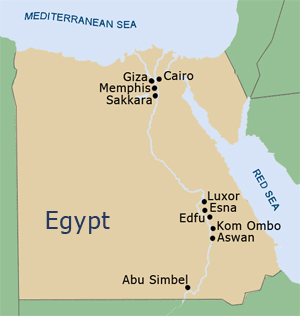
This sphinx in particular was found buried up to its shoulders in sand, with the face exposed to the elements. This resulted in the erosion of the facial features and part of the false beard (a symbol of divine royalty). Inscriptions on the chest and around the base of the statue list the five names of Rameses II. Following his death, Ramses II's son Merenptah added his names in cartouches to the shoulders of the sphinx. The sphinx was sculpted from red granite that was quarried at Aswan and transported by river to Merenptah's temple at Memphis. How this was done is still speculated, but it is apparent that the transportation occurred. The map to the left illustrates the location of Aswan and Memphis.
The sphinx is displayed as the prominent object in the Lower Egypt gallery. The entire room is dimly lit to protect the objects, and is also large and open.  Surrounding the sphinx are a number of columns, mostly limestone from the Merenptah Temple (The Great Temple of Ptah) as well as tablets, statues, and other items mostly from the museum's expeditions in the early to mid twentieth century. The sphinx, however, was excavated by the Egyptian Exploration Fund, under the direction of the famous archaeologist, Sir William M. Flinders Petrie (because of this there is always the chance that it will be reclaimed). The sphinx, however, is not from an expedition by the museum but by The combination gives the impression of stepping into an ancient temple. 

The only label on the sphinx is a small one that includes most of the information listed in the first two paragraphs of this blog. It does not offer any definitions or images, however, and so appears to be mostly for those academics that are familiar with Egyptology. Those that are not as familiar may become disinterested in the exhibit due to the need for a greater understanding of the subject. If the museum wishes to attract a broader audience, it may be in the institution's best interest to offer additional labels with a less technical vocabulary. 


An activity that could be used to engage viewers with the object (and others) is something to help teach the basics of hieroglyphics, much like the 'write your won hieroglyphics' kits for children. A kit like this was one that made me interested in Egyptology as a kid, and may do the same for others. So that the activity does not seem out of place in the room, it could be designed as a rubbing kiosk that appears authentic. Another experience that could engage viewers would be interpretations delving further into Egyptian mythology, or speculations as to how it may have been transported up the Nile.

Tuesday, October 25, 2011

Eastern State Penitentiary

Title: Beware the Lily Law
Year: March 2011
Material: Prison bed, A/V equipment, costumes, actors, built into prison cell
Creator:  
Michelle Handelman
Performers: Becca Blackwell, Michael Lynch
Cinematography: Ed David
Sound Design: Vincent Baker
Sound Mix: Dan Bora
Production Assistance: Nadja Marcin
“Spare Change for a Dying Queen” by Jimmy Carnicio
Collection: Artist Installations, adult content cell block


Eastern State Penitentiary has been trying to find ways to bring more people to the museum outside of the haunting season. One of the programs offered to do this are artist installations. These installations are temporary exhibits that are thought provoking or educational that bring to light the history and issues associated with prisons, prisoners, or the personell.


Down the cell block reserved for 'adult content' are some of these installations. All are labeled 'mature content' and this block is marked to feature 'adult content' not recommended for children. One of these is titled “Beware the Lily Law,” created by Michelle Handelman. "Lily Law" was one of the many names street youth used in place of "cops". The piece is installed in one of the cells, which has been arranged to look like it is currently in use. A projector hidden above the doorway on the inside of the cell places the image of the actor (presumably an inmate living in this cell). Also above the doorway are speakers. Together, this creates the illusion that the character on screen lives in the cell and is talking to you (the viewer). The viewer is able to sit inside the cell on a stool and listen to the story of the subject, including what life was like being transgendered before they were incarcerated, how they were arrested, and what their life is like now in the prison. Two subjects are featured (one after the other, and the video is on loop), and both are 'caught on tape' performing the daily routines that allow them to "pass". The first is male to female (shown putting on her makeup), the second female to male (shown working out and then binding his breasts). Each subject tells his or her story about being arrested at the Stonewall Inn during the 1969 Stonewalll Riots in New York City during which police raided the bar and arrested transgendered patrons.

Even today these prisoners are placed in the prisons in which they legally are identified as, meaning female transgenders are placed in male prisons, and males in female prisons. For their protection they are often placed in administrative custody, but this creates mental stress because such custody is essentially solitary confinement.

The installation is not only thought-provoking but highly controversial. An LGBT ally may watch this and be moved through either sadness or anger at seeing what life is like in prison for a transgendered person. Someone who does not have a stance on the subject or is unfamiliar with transgendered people may not understand what the 'big deal' is. Finally, someone who is does not agree with the transgendered lifestyle, is homophobic, or easily offended would likely be disgusted by not only seeing and hearing from a transgendered person but perhaps may be upset that the art piece was even installed. 

The artist clearly is an LGBT ally as the work only features the point of view from that side of the movement for equal rights between homosexuals, heterosexuals, and the people 'in between'. This insinuates that the museum is also supportive, even though it may be attempting to just make the issue known but not take sides.


For anyone unfamiliar with the troubles dealt with by the transgendered community, it would be greatly beneficial to research further into the subject.

Wednesday, October 12, 2011

The American Swedish Historical Museum


Title: Tapestry
Year: 1938
Material: Wool and linen
Creator:  Designed by Märta Måås-Fjetterström, embroidered by twelve women from different provinces of Sweden
Collection: The Fredrika Bremer Room

The tapestry hangs in the back of a recreated mid-19th century Swedish parlor at them American Swedish Historical Museum in Philadelphia. The tapestry, combined with the other objects in the display, help the viewer to better understand the comfortable life Fredrika Bremer grew up with and sacrificed to help others. It features selected quotes from the writings of Fredrika Bremer, chosen by the Swedish Fredrika Bremer Room Committee.

The text translates:
The narrow valley widens
Paths becomemore numerous
There shall be room work
Lightheartedness enough for all
Who honestly seek and desire
If one has felt deeply a single
Grief then one understands
All other sufferers
Every deep longing is a
Prophecy of fulfillment
Every earnest seeking has the promise of finding
Is not faith the royal highway
Of the spirit to that other
All-highest access over the mountain
Gift of Swedish women
It is on display as an homage to both Fredrika Bremer and Swedish women everywhere. It also helps to "set the scene" of the parlor display. It appears the tapestry was made specifically for this room in 1938.

The label describes the tapestry as being "designed by one of Sweden's most famous weaving artists," thereby pointing out the importance of the item and also praising it.

If one is interested in learning more about the tapestry, further readings in the Fredrika Bremer room about her as well as studies of her life and works outside of the museum would help to gain insight. As the Fredrika Bremer room focuses on her work as a philanthropist and women's rights activist, people who are not interested in the history of women's rights or social work would likely not be interested in this room, much less the tapestry. An opposing point of view of the tapestry may come from someone who disagrees with the passages woven into the tapestry.

To further engage viewers with the tapestry, it may prove beneficial to feature a table nearby with the works of Fredrika Bremer that these passages came from so that viewers can read on.

Tuesday, October 4, 2011

The Philadelphia Museum of Art


Title:   Horse Armor of Duke Ulrich of Württemberg for use in the field
Year:   1507
Material:   [Armor] embossed, etched, and partially blued and gilded steel; tail plate replaced; brass; leather; [saddle] birch bark; steel; leather and textiles replaced
Creator:   Wilhelm von Worms the Elder (armorer), German, active Nuremberg, master in 1499, died 1538; and anonymous Nuremberg graphic artist.
Collection:   The Kretzschmar von Kienbusch Collection of Arms and Armor


This work is the most prominently displayed piece in The Kretzschmar von Kienbusch Collection of Arms and Armor at the Phildelphia Museum of Art. For the purposes of this examination, I will focus solely on the horse armor, as it was the only complete set of horse armor within the amory, wheras there were a number of suits displayed. The horse armor was made for Duke Ulrich of Württemberg, who served under the German king Maximilian. It is likely this armor was created for accompanying the king to Rome in 1508, but the king's trip never happened. He was known for his excessive spending on extravagances, as shown in detailed graphics on the armor (which would have been unnecessary for the field).  It is not only important because of the history of its owner, but also because of its creator and its unique qualities. It is the earliest complete set outside of Europe and the only surviving horse armor created by Wilhelm von Worms, who was famous for his skilled craftsmanship. This rich history is my guess as to why it is displayed, in addition the the beautiful craftsmanship and etchings.


The armor was acquired through a gift of Athena and Nicholas Karabots and the Karabots Foundation in 2009. The gallery itself is five rooms (two smaller rooms on either side of the main room). The armor is displayed on the sculpture of a horse, placed on a small stage at the center back of the room, perfectly centered between two windows. The entire room has been decorated in such a way as to "set the scene". Other objects in the room include more suits of armor, spears, shields, stained glass, and even a faux crow perched in one of the "castle" windows. 


A suit of armor has been put together and placed on top of the horse, posed as if riding to create the illusion of a knight and his horse prepared for battle. On either side are descriptions of the armor (the left being the knight's suit, the right being the horse's armor). 


The interpretation is written concisely in third person, and includes information not only on the armor but the armorer and the Duke. Despite the author's attempt to make the information appear impartial, however, their admiration of the work is apparent.


The study of European armor, German craftsmanship, or German history may all be useful subjects to focus on. As a fan of history in general, old trades, and reenactment (and an occasional reenactor myself) I was interested in studying practically anything in this gallery. Someone who does not enjoy studying the subject of arms or armaments  may not be interested in the horse armor, much less the gallery as a whole. As the label did not at all describe the dislike many of the Duke's subjects have for him or his infamous history, someone familiar with this may have something to say about the unnecessary extravagance of the horse's armor. The presence of an interpreter may engage viewers with the subject, though this likely exists for tours already. I would be hesitant to add any sort of interactive or additional decor to the room, as it is very fitting already and the inclusion of technology would contradict the theme. 

Monday, September 19, 2011

The National Constitution Center

Title: Flags of the United States of America
Year: 2003
Material: Metal, fabric, wire (for hanging flags), stone
Creator: Unknown
Collection: Lobby

Creating a half-circle above the second floor of the main lobby to the National Constitution Center is a long row of flags. These flags are those of the United States' fifty states, as well as the unincorporated territories. The individual flags are important to those people who have a special tie to that state or territory, and the collection as a whole is important to anyone who is a citizen of the United States, or perhaps not but wishes to understand more about the country. The flags are on display to not only recognize the individual regions of the country, but to show the order in which the states and territories became a part of the United States.

I am unsure of how the individual flags were acquired, but I would venture to guess they were either donated by members of the individual states, or purchased directly by the center. The flags are hung from wire attached to a metal mount that encircles the center edge of the second floor of the lobby. Below each of these flags is an engraved block of stone laid into the floor with the name of the state or territory the flag represents, and the date it became a part of the United States (the first thirteen are in order of ratification of the Constitution). What I found most interesting was the fact the mount for the flags extended past the last territory  perhaps on purpose to leave room in case more are acquired. The point of view of these labels are objective-- there is no additional information given as to the history of each state, and so there is nothing written that might effect how the objects were interpreted.

There are no other objects around the flags that might contribute to an understanding of the exhibit. There is however a life-sized board game, and perhaps there are questions in the game we did not come across that are relevant to the flags. The significance of the flags might be better understood following research into the history of the growth of the United States, and after studying the laws that determine statehood versus being an unincorporated territory. Someone not from the United States that does not understand the significance of individual states might not be interested in the flags. As there is no point of view involved with the interpretation of the object, it would be hard for a different narrative to be told about it. The only opposing point of view I might expect to hear would be a complaint by someone that the territories are included in the series despite them not being a state.

Viewers might become more engaged with the display if there was an interpretation perhaps along the wall of the second floor walkway describing a brief history of the state and its acquisition by the United States. This could also be achieved with brief discussions given by an interpreter.